Our
projects
High-power rocketry doesn't need a high carbon footprint. Meet the Scorpion programme, our line of flax-fibre rockets built from scratch in our Ghent workshop.
T-minus EuRoC 2026
15–22 Oct · EuRoC 2026 ↗Project 02 · Flagship
Scorpion II
Our entry for the European Rocketry Challenge 2026. A single-stage rocket built around a bio-based composite airframe, flying a dual-parachute recovery system, in-house avionics and a scientific payload. The mission: fly to 3 km, bring it home safely, and prove that sustainable rocketry doesn't compromise on performance.

Unveiled
9 October
0m
Target apogee
3 km COTS class
0m/s
Peak velocity
~1060 km/h
0.0s
Motor burn
Aerotech L2500ST
0.0kN
Average thrust
4668 Ns total impulse
0.0kg
Lift-off mass
Fully loaded
0.0m
Length
10 cm diameter
Flax-fibre airframe
Hull, couplers, fins and nosecone are woven flax with a plant-based bio-epoxy — a first on the European high-power launch scene.
In-house flight computer
Our own SRAD flight computer detects launch and apogee, paired with a commercial CATS Vega for full redundancy.
CO₂ recovery
A custom CO₂ ejection system pops the drogue at apogee; the main parachute opens at 430 m.
BIO-SAVIOR payload
A camera and sensors film a blood analogue sloshing in flight, studying how launch loads affect blood-like fluids.
Flight plan
T+0s
Lift-off
38.5 m/s off the rail
T+1.9s
Burnout
295 m/s at 280 m
T+24.2s
Apogee
~3000 m · drogue out
T+73s
Main chute
430 m · slows to 5 m/s
T+108s
Touch-down
Buzzer on, go find it
Testbed · Recovery & avionics
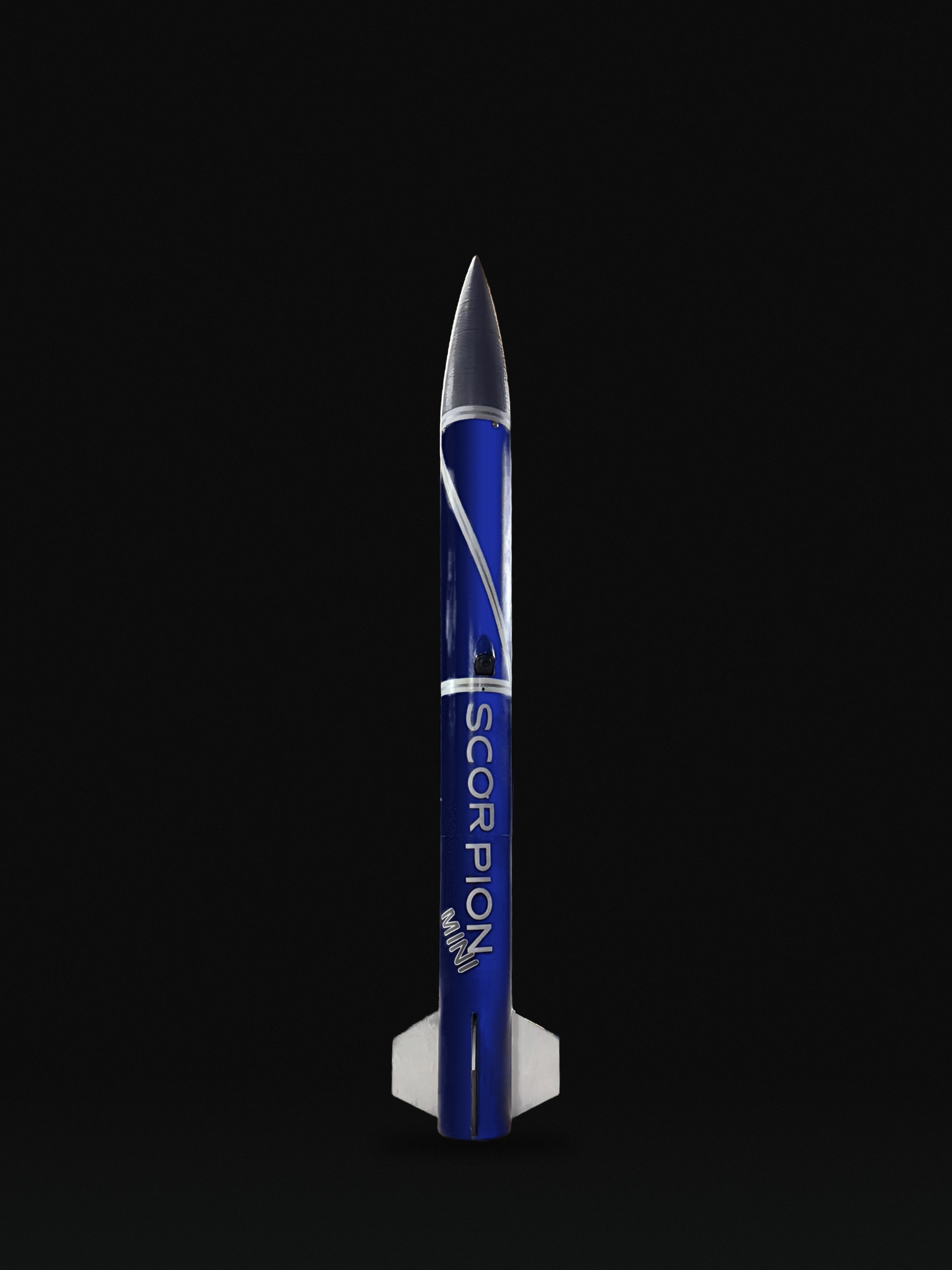
Scorpion Mini
Built after Scorpion I and before Scorpion II, Scorpion Mini was our testbed. It flew a motor we made ourselves, from the propellant to the casing and nozzle, to flight-test our recovery system and first-generation electronics, and reached 230 m on a nominal flight.
0m
Apogee
Nominal flight
0m/s
Peak velocity
0s
Motor burn
Custom motor
0N
Peak thrust
Custom motor
0.00kg
Lift-off mass
0.00m
Length
10 cm diameter
Recovery testbed
Scorpion Mini flight-tested our recovery system ahead of Scorpion II, with a nominal flight to 230 m.
Custom motor
A motor made in-house: our own propellant in an aluminium casing with a graphite nozzle.
V1 electronics
It carried the first version of our electronics, proving them in real flight conditions.
Built from spares
Put together from spare parts and materials after Scorpion I's launch was postponed, and flown at a local launch event in Belgium.
Project 01 · First build
Scorpion I
Our first complete rocket, and the proof that a high-power airframe can be built from flax. Scorpion I flies a smaller K-class motor and the same dual-deployment recovery system as Scorpion II. Its maiden flight is planned for late 2026.

TBD
Target apogee
TBD
TBD
Peak velocity
TBD
TBD
Motor burn
TBD
TBD
Average thrust
TBD
0.0kg
Lift-off mass
Fully loaded
0.0m
Length
10 cm diameter
Flax-fibre airframe
Hull tubes, couplers and nosecone are hand-laid flax composite, and the plywood fins are reinforced with a flax tip-to-tip layup.
CO₂ recovery
Two CO₂ ejection systems push out the drogue at apogee; two tether releases free the main parachute at 400 m.
Instrumented airframe
A pressure sensor in the drogue bay, a force gauge on the shock cords and three motor temperature sensors record what the rocket goes through.
Flax Fibre supported by GSR